
Point Puer Boys Reformatory 1834-1849
Perched on a small peninsula opposite Port Arthur, Point Puer was one of the earliest institutions created specifically for young offenders in the British Empire. Operating between 1834 and 1849, it housed more than 2,000 boys transported to Van Diemen’s Land from Britain and Ireland. Established to separate young convicts from adult prisoners, Point Puer was intended to reform them through education, religion, discipline and labour. Yet it was also a trade training institution, designed to transform boys considered unsuitable for colonial labour into productive workers.
Today, the site forms part of the Port Arthur Historic Site World Heritage landscape. Although most of the structures from the Point Puer era are no longer standing, archaeological remains survive across the peninsula, including building foundations, a quarry, roads, recreational spaces and evidence of the industries undertaken by the boys. These remains provide a rare opportunity to explore how juvenile punishment and reform were experienced in the nineteenth century.
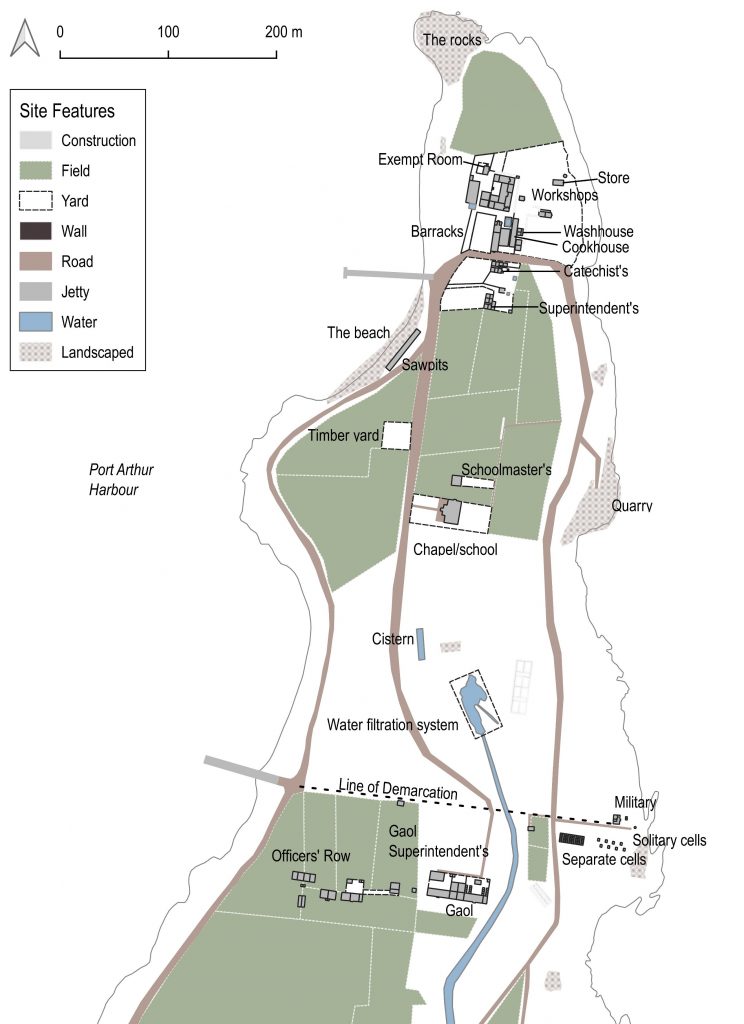 Research at Point Puer combines archaeological survey, historical records, GIS mapping and LiDAR remote sensing to reconstruct the institution and the lives of its inmates (see figure above). Historical plans, labour records, conduct registers and thousands of offence records have been integrated with archaeological evidence to reconstruct the Point Puer landscape, how it changed over time and how its occupants moved through and used space.
Unlike adult penal stations, Point Puer was shaped by ideas about youth, training and future potential. The boys were taught trades including shoemaking, carpentry, masonry and blacksmithing, while also undertaking quarrying, sawing, agriculture and construction work. In fact, much of the institution was built by the boys themselves. Their labour produced buildings, roads and industrial facilities that allowed the settlement to function while simultaneously serving as a form of reform and instruction.
The landscape also reveals the social lives of its young inhabitants. Boys created spaces for recreation, developed friendships and formed communities within the institution. One notable area, known as “the rocks”, became a popular place for play, exploration and socialising. Historical and archaeological evidence shows that boys often used peripheral spaces such as beaches and rocky shorelines for recreation, fishing and, at times, avoiding supervision.
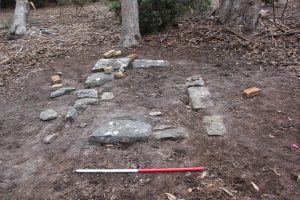 Point Puer was also a place of punishment. Boys who broke regulations could face confinement, corporal punishment or other disciplinary actions. Archaeological remains of solitary cells (see image at right), gaol facilities and other punishment spaces show how administrators attempted to maintain order. Yet the records also reveal that young inmates actively shaped the institution through their responses to authority. Absconding, absenteeism, theft and group resistance were common forms of non-compliance, often differing from the behaviour patterns seen among adult convicts elsewhere in Van Diemen’s Land.
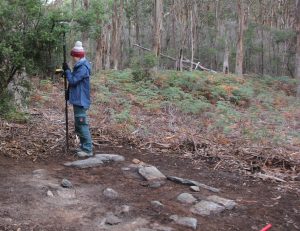 This research views Point Puer not simply as a prison, but as a landscape where ideas about childhood, labour, morality and punishment intersected. The site reflects a period when governments and reformers were beginning to treat young offenders differently from adults, creating specialised institutions intended to shape future citizens and workers. Through archaeology, we can trace how these ambitions were physically expressed across the landscape and how the boys themselves influenced the place through their daily activities, labour, play and resistance
Acknowledgements
Martin Gibbs (UNE), Richard Tuffin (UNE) and David Roe
Support from PAHSMA staff: Sylvana Szydzik and David Roe
Fieldwork volunteers: Sophie Jennings, Jane McMahon and Erin Mein
Transcription volunteers: Ruth Dircks, Betty Core, Jo Anne Simpson, Jacqueline Dircks, Ali Court and Peter MacFie
Key Personnel:
Dr Caitlin D’Gluyas