
Mapping Port Arthur 1830-1877
One key aspect of our project was the melding of historical and spatial data. Like all good historical archaeologists, bringing together historical, archaeological and built evidence is how we repopulate landscapes with past lives and labours.
Despite a long history of heritage management, Port Arthur had never been spatially reconstructed across its 47 year history. We took this as a challenge. Using historic maps and plans, as well as documentary evidence, we rebuilt the settlement building-by-building in GIS (see image, below). Where available, we even recreated the room spaces within the buildings. Hundreds of different structures were researched and drawn, capturing the settlement as it changed year by year. We even recorded how fencelines and roads changed. It was all about reconstructing historic spaces.
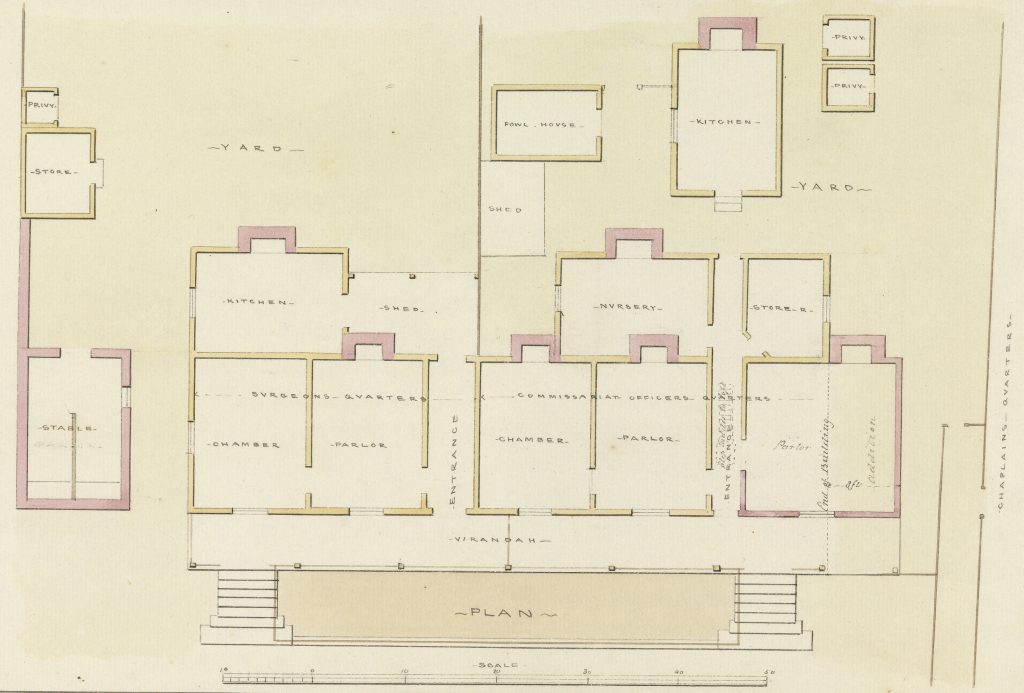
Plan of Commissariat Officer’s and Surgeon’s Quarters by Henry Laing, 1836 (Tasmanian Archives)
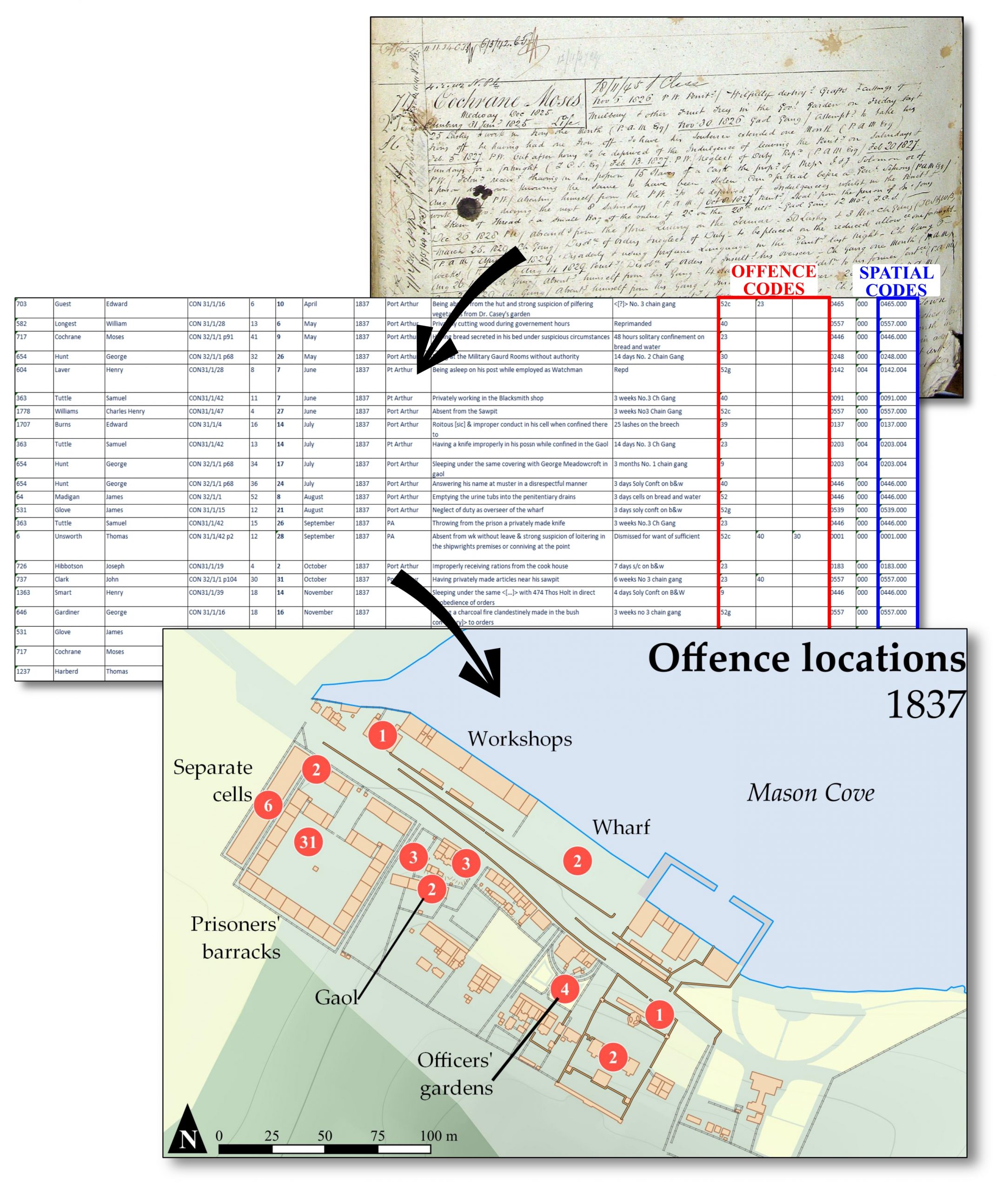
With the station reconstructed, we were then able to repopulate it with people. A key resource was conduct records. An administrative document that detailed a convict’s offending record under sentence, we realised that many conduct records contained details of the time and place where an offence occurred (see image, below). Thousands of records were transcribed by a team of volunteers led by Sue Hood, at the time PAHSMA’s Resource Centre manager. These were then geocoded to show when and where offences occurred – literally putting people back in place.
Key Personnel:
Dr Richard Tuffin
Professor Martin Gibbs
Grants:
Australian Research Council Discovery Grant, DP170103642
Below is out time-sensitive map of Port Arthur. Use it to explore how the station drastically changed over 47 years. See where offences occurred, or look up somebody of interest. You can also turn on and off historic overlays, showing some of the maps and plans that were instrumental in reconstructing the station. Use the external link to view the map in another window.